Andrew MacWhirter
Towards ZeroAndrew MacWhirter’s part in the story turns on two acts of intervention: at Stark Head he catches Audrey Strange before she goes over the cliff; later, in the investigation of Lady Tressilian’s murder, he presents Superintendent Battle with an account that sounds like eyewitness testimony but is actually a deliberate fabrication. The contrast makes him both a rescuer and an unreliable witness, while the mistaken parcel of clothes supplies the material clue from which he constructs his claim.
Identity and Inner State
At the Easterhead Bay Hotel, MacWhirter sits on the terrace looking across the river towards Stark Head. The scene begins not with action but with an examination of himself: during his last few days of leisure, he takes stock of his thoughts and emotions, and cannot quite explain why he has chosen this place. He suspects that he has been drawn there to test whether any of his former despair remains. The uncertainty matters. He does not describe a settled purpose or a resolved recovery; he is measuring himself against a state he fears may still be present.
The setting gives that inward test a visible counterpart. Stark Head stands opposite the hotel, a height across the river that will become the scene of an immediate, life-or-death decision. The movement from watching the headland at a distance to rushing towards someone at its edge turns MacWhirter’s private stocktaking into action. The story does not present that action as proof that his own despair has disappeared; it shows instead that, when he recognizes desperation in another person, he can respond decisively.
The Misidentified Suit
A parcel from the 24-Hour Cleaners interrupts MacWhirter’s ordinary hotel routine. He has expected the dark blue suit he left with them, but the parcel contains a suit that is not his and is not even the same colour. Its label nevertheless bears the name MacWhirter. He first treats the mismatch as an irritating mix-up, wondering whether another person with the same surname or a careless interchange of labels explains it. The label is correct in one narrow sense, but it does not establish that the garment inside is his.
That distinction later becomes central to the account he gives the police. The wrong suit is not simply an inconvenience: MacWhirter identifies it as part of the basis for his reconstruction of what happened. When he recalls it, he also says that his suppositions were confirmed by the discovery of a wet rope in the attic. The disclosed facts support the importance of the suit as a clue in his reasoning, but not the claim that he directly witnessed someone climbing the rope. The parcel’s apparent connection to him gives him material from which to deduce; it does not make the deduction an observation.
Rescue at Stark Head
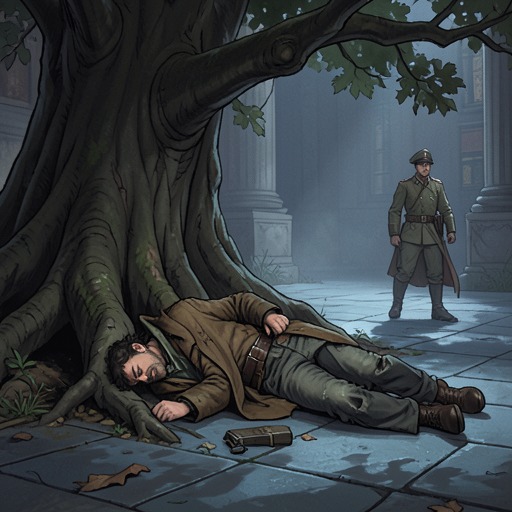
At night, MacWhirter sees a white-clad figure running towards the cliff edge. The suddenness of the appearance is matched by the speed of his response: he recognizes the desperation in the woman’s flight, rushes out of the shadows, and catches her just as she is about to go over. The scene identifies the woman as Audrey Strange, whose later reaction to his account confirms her connection to the events. His intervention prevents her fall, though the episode does not make the longer effects of her distress disappear.
MacWhirter’s recognition is presented as personal rather than abstract. He knows what desperation means, and that recognition prompts him to act before he can stand aside and assess the situation. The rescue therefore gives his earlier self-examination an unexpected consequence: a place he may have chosen to test his own former despair becomes the setting in which he uses that recognition to save someone else. The scene does not explain every cause of Audrey’s crisis, but it establishes the immediacy of MacWhirter’s response and the physical fact of her rescue.
Testimony and Its Limits
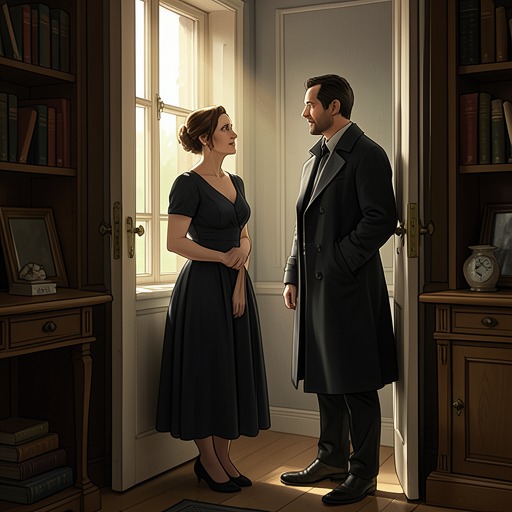
MacWhirter eventually approaches Superintendent Battle and says that he has an important statement about something he believes he saw on the Monday night. He apologizes for not coming forward earlier, explaining that the importance of the observation has only just dawned on him, and asks to speak privately. His entrance gives the statement the appearance of newly recognized eyewitness evidence. The later clarification reverses that impression.
When questioned about the man on the rope, MacWhirter admits that he did not actually see anyone climbing it. He could not have seen that event on Monday, he explains, because he was on Stark Head on Sunday night, not Monday. What he offered as sight was a deduction: he inferred what must have happened from the suit and his other suppositions, then treated the wet rope found in the attic as confirmation. He says that deductions alone would not have carried weight with the police, so he claimed to have seen what happened. His statement thus combines an actual location and an actual clue with a false assertion about how he acquired his knowledge.
Audrey Strange reacts with disbelief when she understands that the story was a lie. That response marks the disclosure as more than a technical correction to a police report: MacWhirter’s effort to make an inference persuasive has also misrepresented the grounds on which others are being asked to believe him. The account establishes his deliberate choice to claim firsthand observation, but it does not establish every motive behind that choice or show what formal consequence the admission has for the investigation.
Narrative Role and Significance
MacWhirter’s episodes repeatedly distinguish what is seen from what is inferred. The mismarked parcel looks as though it belongs to him because it carries his name, although the suit inside is not the dark blue one he left for cleaning. In the later investigation, the wet rope and his deductions allow him to construct an account, but he acknowledges that the account’s eyewitness element is false. In both cases, a true detail—the label, the rope, his presence at Stark Head—can be made to suggest more than it proves.
That pattern also sets his rescue apart from his testimony. At the cliff, his knowledge of desperation leads directly to a verifiable physical act: he catches Audrey Strange. In the police inquiry, by contrast, he turns deduction into a claim of sight because he believes the unembellished version would carry insufficient weight. The novel therefore gives his courage and his unreliability distinct forms rather than allowing one to cancel the other. His role remains consequential precisely because he can act with certainty in the moment and still distort the truth when trying to make his later account convincing.